
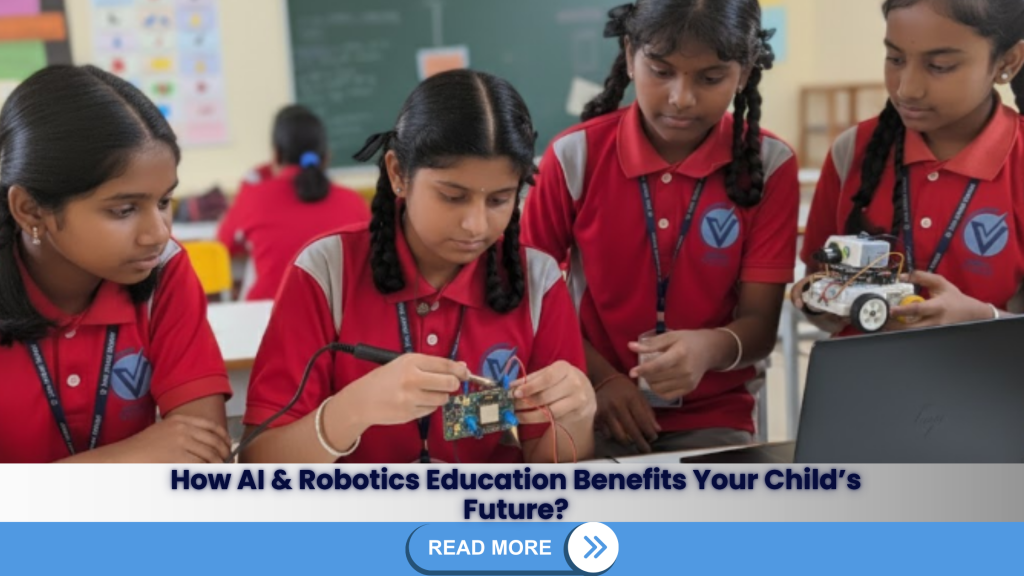
Ten years ago, “Artificial Intelligence” was a plot for sci-fi movies. Today, it dictates what we watch on Netflix, how we bank, and how we drive. By the time a student entering Grade 1 today graduates from college, the world will look vastly different.
Integrating AI and Robotics into school education isn’t just about teaching children how to code; it’s about teaching them how to survive and thrive in a tech-first world. Here is why this education is the best investment for your child’s future.
1. Future-Proofing Their Careers
The most obvious benefit is career readiness. According to the World Economic Forum, 85 million jobs may be displaced by a shift in the division of labour between humans and machines, but 97 million new roles will emerge.
- New Roles: These new jobs (Data Analysts, AI Specialists, Robotics Engineers) will require a deep understanding of technology.
- Fluency: Even for non-tech careers (like Medicine or Law), professionals will need to work alongside AI tools. Early exposure makes technology a comfortable colleague rather than an intimidating replacement.
2. Developing “Computational Thinking”
Robotics teaches a specific way of thinking called Computational Thinking. It involves breaking a big problem into smaller steps (decomposition) and creating a step-by-step solution (algorithms).
Logical Progression: When a child programs a robot to walk in a square, they learn that steps must happen in a specific order. If they miss a step, the robot fails. This builds strong logical reasoning skills applicable to any subject.
3. Turning “Passive Users” into “Active Creators”
Most children today are “Digital Natives,” but they are often passive consumers—scrolling, watching, and clicking
4. Enhancing Creativity and Innovation
Robotics is surprisingly creative. It is engineering mixed with art.
Open-Ended Challenges: Give a class a box of sensors and motors and ask them to “build something that cleans a desk,” and you will get 20 different designs. This encourages out-of-the-box thinking and proves there is often more than one right answer to a problem.
5. Resilience and the “Debug” Mindset
In Robotics, things rarely work the first time. A code might have a bug; a wire might be loose.
Embracing Failure: Children learn that failure is not the end—it is just information. They learn to “debug” their errors. This builds grit and resilience, teaching them that persistence leads to success.
6. Making Math and Science Real
“Why do I need to learn Algebra?” is a common question. Robotics provides the answer.
Applied Knowledge: Abstract concepts like geometry (angles for turning), physics (velocity and torque), and variables become concrete when a child sees them in action on a robot they built themselves.
Conclusion
AI and Robotics education does not mean every child must become a software engineer. It means every child should possess the critical thinking, adaptability, and technological fluency required to navigate the 21st century. By introducing these skills early, we aren’t just preparing them for a job; we are preparing them to shape the future.